Ikeja, Lagos, Nigeria
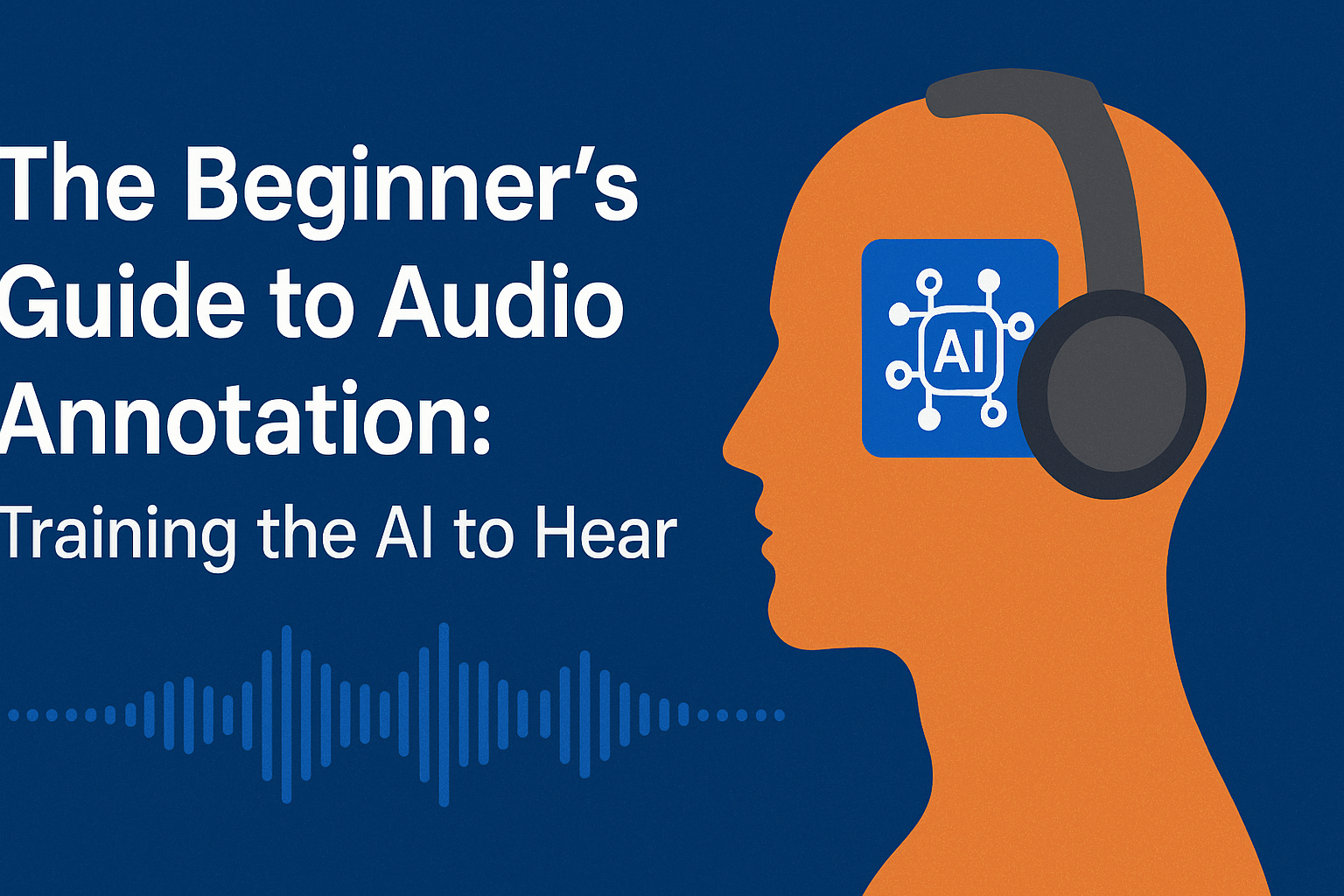
The greatest advancements in AI don’t come from complex code alone; they come from highly structured human input. The entire AI industry is powered by your ability to apply context, linguistic nuance, and real-world judgment to raw data.
The human element—the annotator—is not just a stopgap; it is the quality control and ethical compass for every voice assistant, autonomous vehicle, and health-monitoring system. By mastering audio annotation, you are taking a critical role in shaping the safety and accuracy of the next generation of technology.
A Real-Life Story: The Case of the Wailing Baby Monitor
A few years ago, many smart baby monitors were upgraded with a seemingly simple AI feature: a “Cry Detection” alert. Early versions of these AI models were prone to alarming parents unnecessarily—waking them up because the AI confused a barking dog, a loud sneeze, or a squeaky floorboard with a baby’s cry.
The Solution? Audio Annotation. A dedicated team of human annotators had to meticulously listen to thousands of hours of audio, not just marking where the baby cried, but also precisely labelling and time-stamping every other sound: [dishwasher_running], [dog_barking], [adult_speech]. This human-labelled data taught the AI the crucial difference between a genuine emergency and background interference.
What Exactly is Audio Annotation?
Audio annotation is the essential process of attaching descriptive labels, tags, or time boundaries to segments of audio data. You are essentially giving a machine learning model the “ground truth” to help it categorise, identify, and understand the sounds it hears.
Why Is It So Important?
AI models learn through supervised learning. They need high-quality, pre-labelled data to form connections between an input (a sound clip) and a desired output (the label). Without human-annotated data, the AI is effectively deaf and unable to generalise its understanding to the complex, noisy reality of the world.
🎙️ The 3 Main Types of Audio Annotation
| Annotation Type | What You Do | Primary Use Cases |
| 1. Speech Transcription | Convert spoken audio into written text, often including speaker identification (Speaker Diarization). | Voice assistants (Siri, Alexa), call centre automation, and medical dictation. |
| 2. Time-Stamping & Segmentation | Identify speech boundaries or specific sounds (like a keyword) and mark their precise start and end times on a timeline. | Training AI to recognise commands in noisy environments and real-time closed captioning. |
| 3. Sound Event Labelling | Classify non-speech sounds into distinct categories (e.g., siren, glass breaking, cough). | Autonomous vehicle safety, security monitoring (alarms), health tech (coughs). |
Essential Tools & Hardware for Beginners
To work professionally, you need to hear what the AI cannot yet understand. This requires the right hardware and a clear understanding of the software landscape.
1. The Hardware: Your Ears
You cannot annotate what you cannot hear clearly.
- Wired Over-Ear Headphones: This is non-negotiable. Bluetooth compresses audio and introduces latency (lag). For professional annotation, use wired headphones to ensure you are hearing the raw, uncompressed file without interference.
- Quiet Environment: A distraction-free space is essential to maintain high quality and concentration, especially when dealing with complex or noisy audio files.
2. The Software: Editors vs. Annotators
It is vital to understand the difference between Audio Editors (which change the sound file) and Annotation Platforms (which create a data layer on top of the sound file).
| Tool Category | Recommended Tool | Best For | Professional Note |
| Audio Editor (Destructive) | Audacity | Visualisation & Cleaning. Great for seeing what a waveform looks like and learning to isolate sounds. | Use this to practice listening and seeing sound. In real work, you rarely edit the file itself. |
| Linguistic Tool (Non-Destructive) | ELAN | Complex Transcription. The industry standard for academic and linguistic projects. | It creates a separate metadata file (XML) for your tags, leaving the original audio untouched. |
| Open-Source Platform | Label Studio | Workflow Simulation. A versatile web-based tool supporting audio, image, and text. | Excellent for learning how “bounding boxes” work on audio timelines (spectrograms). |
| Proprietary Platforms | Labelbox, Appen, Scale AI | Paid Work. These are the enterprise tools provided by the hiring company. | You generally learn these specialised tools on the job during qualification. |
💰 Understanding Payment: From Transcription to Annotation
Compensation structures reward quality and complexity. Your goal is to move from basic Per Audio Minute (PAM) transcription to complex, higher-paying AI annotation tasks.
| Task Complexity | Typical Payment Structure | Estimated Rate (Effective Hourly) |
| Basic Transcription | Per Audio Minute (PAM) | $5 – $18 per hour |
| General Audio Annotation | Per Task/Per Audio Hour (PAH) | $18 – $25 per hour |
| Specialised AI Annotation | Per Hour (Contract/W-2) | $25 – $45+ per hour |
Note: Rates are highly dependent on your geographic location, language pair, and the specific platform’s pricing structure. Beginners often start at the lower end.
Your Goal: Master the Label Schema (the ruleset) and focus on accuracy. High accuracy on complex tasks (like sentiment analysis or speaker diarization) is what unlocks the top-tier project rates.
🌐 Companies, Training, and Communities for Jobs
To transition from a beginner to a professional annotator, prioritise high-quality training and direct experience with major data providers.
I. Training & Certification Resources
The most valuable training teaches best practices and rigorous quality control.
- Beyond Human Intelligence (BHI) Academy: Offers comprehensive training programs covering all data annotation modalities (including audio, image, and text). They focus on industry best practices, tool proficiency, and the annotator’s role in ethical AI development.
- DeeLab Academy: Provides focused Data Labelling Essentials courses and certification tracks designed to teach core annotation tasks, tool proficiency, and industry-standard quality practices.
- Internal Company Qualification Modules: The actual qualification exams provided by major platforms (like Appen or TELUS) are the most critical “training.” Passing these high-accuracy tests for specific projects is the truest certification of your skill.
II. Major AI Data Companies (Job Platforms)
These companies recruit globally and provide the necessary proprietary tools and training modules for their projects. They are the best place to find paid entry-level work.
- Appen: One of the largest crowd work platforms, offering a massive volume of projects, including speech-to-text and linguistic annotation.
- TELUS International AI Data Solutions (formerly Lionbridge): A major provider of AI training data, frequently hiring annotators and evaluators for voice assistants and NLP projects.
- Scale AI / Data Annotation: Known for working on the cutting edge of LLM data. They provide competitive rates for high-quality, complex annotation work and frequently offer skills assessments.
- RWS / TrainAI (LXT, Welocalize): Manages a large community of AI data specialists across various modalities, focusing on translation, linguistic, and data annotation services.
III. Online Communities (Networking & Support)
- Reddit Communities: Look for subreddits like r/WorkOnline or platform-specific subreddits. These are excellent resources for troubleshooting project issues and finding news on new project availability.
- Specialised Freelancer Platforms (Upwork & Fiverr): Offer your skills directly to clients looking for “speech-to-text” or “audio labelling,” which can lead to higher-paying, project-based contract work once you have experience.
- LinkedIn Groups: Search for professional groups focused on “AI Training Data” or “Machine Learning Labelling” for professional networking and finding direct contract roles.
Your journey in audio annotation is one of continuous quality improvement. Focus on the tools and resources—like BHI Academy, professional headphones, and non-destructive software—that enhance your attention to detail and adherence to complex rules. By doing so, you ensure your work is valuable, and you guarantee your place in the future of AI.